
Ruelle
The auction hall smells like wool and sweat and the metallic bite of whatever they use to clean the floors between sales.
Livestock in the morning.
Women in the evening.
Somebody thought that was fine.
The tile is still damp.
I’m not in the holding pen. I paid the auctioneer’s entry fee two hours ago, told his assistant I needed the privy, and didn’t come back.
Nobody noticed. Nobody tracks the last lot of the night.
I’ve been in the crowd since then, reading the room, running my fingers along the stonework of the nearest column, cataloging moth species around the torches. My brain does this constantly.
It’s part of how I’m in the position I’m in.
Reading people, rooms, compounds, the way a body moves when it’s hiding something.
It’s the one professional skill I still have, which is funny, because it’s also the one that ended my career.
You’d think that would have taught me something.
Apparently not.
Three of tonight’s buyers are creatures I could name on sight. Two are things I’ve never seen before, and my brain is already turning them over.
The way the one breathes, the faint color shift along the other’s mandible, whether that outer layer is skin or something I’d need a sample to understand. Under better conditions I’d want a scalpel and a sample jar.
Under these conditions I’m just standing here looking, and I can’t make myself stop looking, which is the whole problem in miniature. The problem in general, actually. The miniature is generous.
The rest of the buyers are humans with more gold than sense, bidding on women the way they’d bid on horses, checking teeth and hips and whatever else they think predicts value. One of them squeezes a woman’s arm to test the muscle tone.
She doesn’t flinch.
I would have bitten him, but I have a professional reputation to consider.
Had. I had a professional reputation.
Now I have the kind that precedes you into walled cities and gets the gate slammed before you arrive.
Now I have a pack with four working vials, a notebook, nineteen sealed samples I couldn’t bring myself to abandon, and the clothes I’m standing in.
The Arrenval guild was one of the few that still practiced real science. Not hedge-craft or folk remedies. Controlled variables, documented results. We were rebuilding what the old world lost, one compound at a time. They threw me out seven months ago.
The bride market isn’t the worst thing that’s happened to me this year.
It’s not even close.
Lot twelve goes. Lot thirteen.
The crowd thins as buyers leave with their purchases. The torches burn lower.
The auctioneer is tired. His assistant is stacking bid paddles.
And then I see him.
He’s standing against the far column. Alone.
He’s been there all night, I realize. I didn’t notice him because he wasn’t bidding, and I was watching the bidders.
But now the crowd has thinned enough that his outline is clear, and my body goes still. Something dangerous.
Tall. Broad across the shoulders, narrowing to something I can’t see below the remaining crowd.
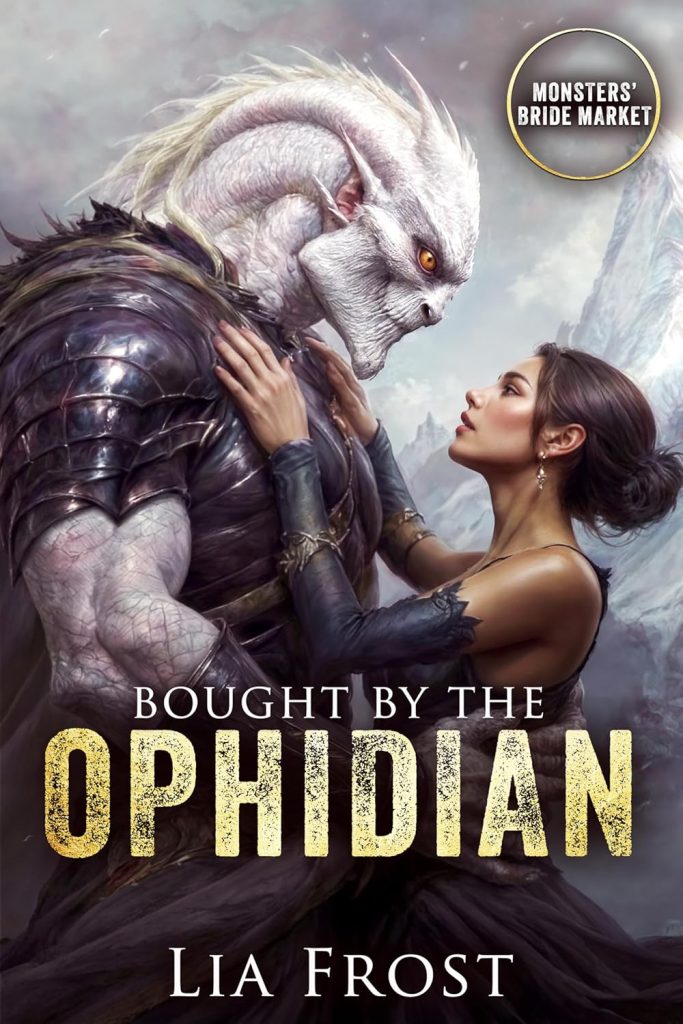
Humanoid. Pale scales, pearl-white, overlapping in plates across his arms and collarbone. Thicker at the shoulders than at the neck. The kind of natural defense that makes steel redundant. And makes me want to know, right now, whether each plate moves independently or whether they lock against each other when he flexes.
Amber eyes catching the torchlight. The skull is angular, elongated, the back of the head swept into a crest of bony ridges I couldn’t draw from memory but want to.
The snout is pronounced. The jaw is heavier than a human’s.
Dark armor over the scales, functional, no ornamentation, which is interesting. Most apex predators I’ve encountered decorate themselves, and this one hasn’t.
Fangs visible behind closed lips, the tips resting on his lower jaw.
Everyone else in this room would see the fangs first.
Three visible from this distance, and up close there’ll be more. One on his left shoulder, spreading toward the neck, the edges irregular, cellular death advancing in an uneven front.
One across his right forearm where the scale plates thin out and the skin shows through dull ash instead of pearl. One at the base of his throat where the scales should be brightest and aren’t.
Flat where they should refract. The surface texture reads like dehydration, but it’s not dehydration.
It’s deterioration.
I’ve seen it in shed samples and in preserved specimens and in one live subject, years ago, a desert viper brought to the guild hall in a cage, already too far gone. I’ve been looking at him for thirty seconds and I already want to get closer.
I see the tremor in his hands. Both hands.
The right worse than the left. He’s pressing them flat against his thighs because he can’t control what they’re doing and doesn’t want anyone to notice.
The particular flatness of his palms against his legs is something I recognize so completely it’s almost embarrassing.
I know what that looks like. I’ve had that same tremor for five years.
Venom sickness. Self-toxicity.
Scales die first. Then the nerves.
He’ll be dead in months.
Maybe less.
And he came to the bride market because he’s running out of options.
I leave the crowd. I’d like to tell you I walked toward him.
The few people between us step aside without thinking about it. Something about the way I move, or the scars on my forearms, or the expression that eleven rejections and seven months of walking have put on my face.
He watches me approach. His gold eyes are flat.
Guarded. The pupils are vertical slits that contract slightly as I get closer.
Heat-sensitive. He’s reading my thermal signature right now, whether he wants to or not. Oh, he’s picking up my body temperature from six feet, what’s the resolution on that, can he read pulse.
I stop two feet away and look up. He’s tall enough that I have to crane my neck.
Up close, the deterioration is worse. Five, six dull patches, with two more starting along his jawline.
The tremor isn’t just in his hands.
His whole body carries a fine vibration, a system running too hot for too long.
“You’re dying,” I say.
The scales along his throat shift, plates tightening against each other.
“Your venom glands are overproducing. You’ve been self-toxic for at least a year, probably longer. The scale deterioration on your left shoulder is past the tipping point in that region, and the tremor pattern suggests the nerve damage is spreading. Without intervention, you have four to six months.”
He stares at me. I stare back.
“Who are you,” he says. His voice is low.
Rough. A vibration that sits in the chest.
“Ruelle. Poisoner. Formerly of the Arrenval guild, until I pushed one of my compounds past the place I should have stopped and someone got hurt. The guild expelled me. Every walled city has my name on a watch list. Every fringe village locks the gate.”
I flex my left hand. The tremor is visible.
“I know more about venom than anyone alive who isn’t venomous. And you need someone who understands what’s killing you.”
He doesn’t respond for a long time. His eyes move over me.
The scars on my forearms. The tremor.
The road-worn boots. The thin jacket and the pack on the floor beside me that holds everything I own.
“What do you want,” he says.
“Somewhere to go. A door that stays open. And access to the most interesting venom I’ve ever seen in a living specimen.” I look at his throat, where the deterioration is creeping along the gland line, and I catch myself staring, and I look back at his eyes, and I don’t apologize. “Buy me at the auction. I’ll address the venom problem. You provide shelter. Transaction. Clean.”
“You’re offering to fix me.”
“I’m offering to try. Nobody else in this room can.”
Something shifts in his face. Not a smile.
Ophidian facial structure doesn’t lend itself to smiling, which is a shame because the expression is almost there. Something close.
Something that might be relief, or recognition, or the specific expression of a creature who’s been dying in private and just met someone who can read the chart.
“How much,” he says.
“However much it takes. I’ll be honest, the bidding won’t be competitive.”
I turn and walk back toward the holding pen. Behind me, I hear him make a sound.
Not a laugh. Something close to it, broken at the edges.
Making him almost-laugh feels like a small accomplishment, and I notice the accomplishment instead of killing it on arrival. Not a habit I can claim yet, but one I’m trying on.
The auctioneer’s assistant looks up when I reappear. “Long privy break,” she says.
“Digestive issues,” I say. “Terrible condition. Very sympathetic. Put me up next.”
I get the look. The one that says you’re odd and also I don’t get paid enough to care.
She waves me toward the block.
“Lot fifteen.” The auctioneer checks his sheet. Yawns. It’s been a long night and I’m the last one. “Poisoner. Specialized knowledge in toxicology. No dependents. Sound health. Some scarring.”
Some scarring.
I step onto the block.
The wood is rough under my boots. I don’t take them off.
The girl before me went barefoot, ankles showing, and the bidding went fast.
I’m not performing.
I’m standing up here because the market has rules. Stand on the block. Let people bid. Then choose.
The rules don’t say I have to look hopeful about it.
“Do I hear an opening bid?”
Silence.
The room is nearly empty. Most of the serious buyers left after lot twelve.
What’s left is a few stragglers nursing drinks and the Ophidian at the back wall, eyes steady, hands trembling at his sides.
Nobody bids. The silence stretches.
The auctioneer clears his throat. His assistant examines her nails.
I stand on the block and nobody wants me.
The word poisoner is doing what it always does, clearing the room like a bad smell.
“Do I hear any bid at all?” the auctioneer says. He’s looking at me with the expression of a man who wants to go home. “Starting at… let’s say two hundred. Anyone?”
Nothing.
“One hundred?”
A drunk in the corner laughs. Someone whispers the word poisoner to someone else.
I hear it. Like something you’d scrape off your boot.
The Ophidian steps forward. One step.
The crowd, what’s left of it, notices. He’s hard not to notice.
The scales, the fangs, the size of him, the fact that the torchlight catches his eyes and throws it back brighter than it arrived.
“Two thousand gold,” he says.
The silence that follows is a different kind. Not the silence of disinterest.
The silence of a room recalibrating. Two thousand for a lot nobody wanted.
The auctioneer’s eyebrows go up. His assistant stops examining her nails.
“Two thousand gold from the Ophidian,” the auctioneer says. A new energy in his voice. “Do I hear twenty-one hundred?”
Nobody moves. Nobody was going to bid at one hundred.
Nobody’s going to bid at twenty-one hundred.
“Going once.”
I look at him. He looks at me.
“Going twice.”
The almost-smile arrives. I let it.
But the corner of my mouth shifts. A dying monster.
I count that as a win.
“Sold.”
I walk off the block. Down the steps, across the floor.
Straight to him. Two feet away.
“That was dramatic,” I say. “Two thousand. You could have bid two hundred. Nobody was competing.”
“I know what you’re worth.”
I…
I want to say I file it away. That’s what I’d usually do with a sentence like that one, delivered at that pitch, by a creature I’d known for eleven minutes.
File it. Don’t look at it.
Move on.
I don’t file it. It sits in my chest warm and I don’t have anywhere to put it.
“Good,” I say, because that’s what I can manage. “Take your shirt off when we get somewhere private. I need to see the scale deterioration across your back.”
I turn toward the door. Walk out of the auction hall and into the cold.
He follows. His footsteps are heavy on the stone.
Clawed. The sound echoes off the settlement walls and the few people still on the street step aside without being asked.
I flex my left hand. The tremor is there.
My right hand is steady.