
Ruelle
The scale deterioration is worse than I assessed at the market. By a significant margin.
That’s the first professional thing I notice. The first thing I actually notice is the shelf.
He cleared it while I slept. The workbench I’d been eyeing, wiped clean, supplies restacked, and along the front edge someone has carved a shallow lip. Rough work, uneven. Tremor-hands doing careful work in the dark.
He did this for me.
I run a finger along the lip. My vials would sit behind it without rolling. Morning light falls across it right now, clean and gray.
I want to thank him. I open my mouth to say something, you didn’t have to do this, or I noticed, or both, and nothing useful arrives.
He’s sitting against the far wall, eyes open, watching me try to work out what I’d say. I close my mouth again.
Get to work, then.
I set my notebook on the shelf. I set the vials beside it, approximately.
Close enough. The lip holds them.
I spend the first two hours of daylight mapping the deterioration. He sits on the stone floor with his back to me, chest piece removed, while I work my way down the gland line with my fingers.
I press each dull patch the way I used to press testing surfaces. Left side, then right.
Counting as I go, out loud, softly, because the counting lives in my mouth better than it lives in my head.
“Twenty-three dead zones. Fourteen transitional. Look at this, the spread pattern’s asymmetric, which means one side of the gland line’s been overproducing harder than the other, which means. Hm. Which means you favor one side when you sleep, don’t you. Or you did, before the deterioration was symmetrical enough that it didn’t matter.”
He doesn’t answer. I wasn’t really asking.
I’m saying things to keep my hands paced.
“The rest are healthy,” I say to his back. “Not for long. Three months ago this would have been twelve dead zones, maybe fifteen. Six months from now, if nothing changes, the healthy patches will be islands in ash.”
Silence. He’s doing the breathing thing.
Slow, measured, the breathing of someone who has learned to hold himself very carefully in the presence of others. The kind of control that comes from years of making yourself smaller than you are.
I don’t.
The gland line is the key. It runs from the base of his skull to his lower spine, a ridge of specialized tissue under the scale surface where the venom is produced.
In a healthy Ophidian, the gland line should be bright, responsive, the scales there finer and more translucent than the armor plates. His gland line is dim.
The tissue is swollen from overproduction, engorged, the channels backed up with venom that has nowhere to go. I press along the ridge and feel the fluid beneath the scales, warm and dense, the consistency wrong.
Too thick. Stagnating.
“Oh, you poor thing,” I say, and then freeze, because I didn’t mean to say it out loud, and also because you poor thing isn’t what you say to a venomous apex predator with gold eyes and a crest of bony ridges. I keep working.
Pretend I didn’t just say you poor thing to the Ophidian. Pretend is generous. Acknowledge and move past. That’s closer.
Pretend the tips of my fingers aren’t learning his body by touch.
I write it all down. He doesn’t ask to see the numbers.
He sits still and lets me work. The only sounds are my pen on paper and the phrase I probably shouldn’t have let out of my mouth still sitting in the air.
I work lower. Past the gland line terminus, past the transition where the plate armor thins into the finer scales below.
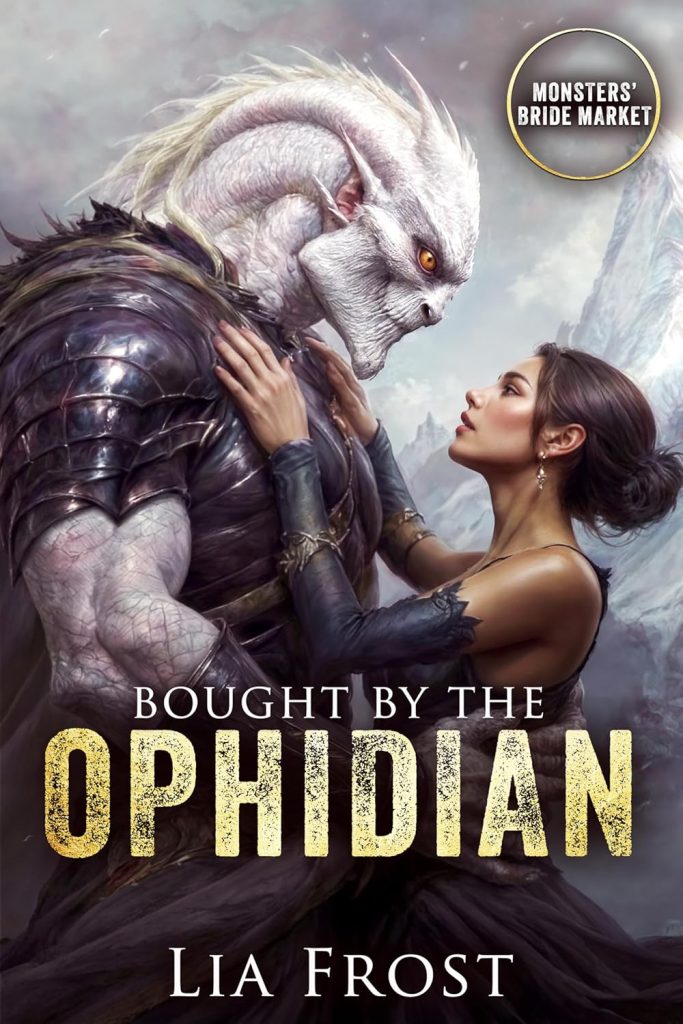
I come around to face him, kneeling. Between his thighs, a ventral slit.
Closed. The scales around it are finer than the armor plates, thinner, intact.
No deterioration.
I press along the margins the way I’ve pressed every other junction, checking tissue response, scale condition, gland line connectivity. The slit is warm.
The tissue underneath responds to the pressure with a subtle shift, involuntary, and I…
Okay. Professional.
I note it and move on.
*Ventral slit, closed. Scales intact, no deterioration observed.
Reproductive structures retractable; slit closes flush when clothed, opens only when armor is off and the subject is aroused. Tail muscular, dense scale coverage continuing the dorsal line, non-prehensile at rest.
Delivery mechanism likely linked to venom gland output. Will require further observation re: bonding function.*
I don’t know who I’m writing that for. Nobody’s going to read these notes.
There’s no guild panel reviewing my research design anymore. I’m writing consistent with species literature.
My fingers were on an Ophidian’s genital slit forty seconds ago and my notebook is where I go when my body is doing things that don’t match my last self-image of who I am.
I make my handwriting careful. It helps.
I don’t linger, even though part of me wants to. There are six more dead zones to map on his lower left side and the light is already shifting.
“I need extracted samples,” I say. “Four draws. One at rest, one after physical exertion, one after sleep, one during an emotional state change. The concentration differentials will tell me how the production cycle responds to metabolic load.”
“I can extract for you.”
“Good. Use these.” I hand him four glass vials from my pack.
The last of my lab equipment. I sold the rest over the past seven months, piece by piece, to buy bread and passage through walled-city checkpoints that turned me away anyway.
The reagent bottles went first, then most of the pipettes, then the testing trays. I kept one pipette.
I kept the vials because a poisoner without sample vials is just a woman with opinions about toxicology, and I wasn’t quite ready to be that yet.
He takes them carefully. His fingers brush mine.
His skin is dry, scaled, warmer than I expected.
I notice the warmth before I name it. That’s unusual.
His skin temperature hits my fingers and for a half-second I’m just feeling it. Warm.
Dry. Alive.
The venom glands underneath producing heat as a metabolic byproduct. I know that because I know venom biochemistry, but the knowing comes after the feeling for once, and I sit with the inversion for another half-second before I hand over the vials and let go.
“And the bite,” I say.
He sets the vials down on the stone shelf. Doesn’t turn around.
“Today.”
“You said tomorrow. It’s tomorrow.”
A long silence. I’ve been reading his back for two hours.
I know every dead patch. I know where the pain starts and where it doesn’t.
I know the gland line better than he does because I can see it and he can’t.
He turns. Gold eyes, level.
The tremor in his hands is worse this morning. He’s not hiding it anymore.
He stopped trying about an hour into the examination, when I pressed a dead zone near his spine. He flinched.
The tremor became visible. I didn’t comment and he didn’t explain.
“The dose will be small,” I say. “Micro-exposure. I need to see how my body responds to the compound at sub-therapeutic levels before I design the full titration schedule. I’ve done this with nineteen other venoms. Yours is more concentrated, but the principle is the same.”
“The principle is the same.” He says it evenly. “My venom kills at contact concentrations that would register as trace amounts for any other species.”
“I know. That’s why I’m designing the titration instead of letting you guess.”
“I don’t guess.”
“You also don’t have a bond-mate, so however you’ve been managing your venom up to this point hasn’t been working. Let me do my job.”
He looks at me for a long time. I hold the look.
I’ve held worse, in rooms with higher stakes, but this one is a different category and I’m not sure why yet.
“Where,” he says.
“Inner forearm.” I push up my sleeve. The scars are there.
Old puncture marks, old reaction welts, the faded map of every venom I’ve tested on my own body over nine years. The left arm is worse.
The right arm I keep cleaner because I need the right hand steady. Needed it, anyway, when steady was part of the job.
I hold out my left forearm. The tremor is visible.
I don’t hide it. I’ve never hidden it.
It’s the cost of the work. I could tell you the work was worth the cost, and there was a time I’d have said that sentence without flinching.
The seventeen people I kept alive at Hessren by identifying the paralytic compound in the water supply before the second wave hit. They think the cost was worth it.
I’m less sure than I used to be. But the tremor isn’t open for discussion today.
He looks at my arm. At the scars.
At the tremor.
“Hold still,” he says.
I hold still.
His hand closes around my wrist. His grip is firm but not painful, his fingers wrapping fully around the joint.
He turns my arm so the inside faces up. My pulse is visible in the crook of my elbow, steady, and I watch his nostrils flare as he registers it.
Reading me. His species can do that.
Heat signatures, chemical outputs. I know this from the literature.
I know what he’s picking up right now, and I don’t care. My blood chemistry is my business.
He lowers his head. His mouth opens, the hinge set further back along the skull than a human’s, the jaw wider than mine could manage.
I get my first close look at the delivery mechanism. Two hollow-point canines, upper jaw, approximately three centimeters in exposed length.
The channels are visible along the anterior surface, fine grooves running from base to tip. Behind them, secondary teeth, shorter, non-venomous, built for grip rather than delivery.
The engineering is beautiful. I mean that.
Whoever built this species. Biology, evolution, time, whichever we’re calling the designer this year.
Knew what they were doing. The fangs are functional and also elegant, and I would like to look at them for a long time from very close up, which is, fortunately, about to happen.
He places his fangs against my inner forearm. Cool at first.
Then the pressure, a puncture, clean and fast. Two points of entry, perfectly placed along the radial line where the absorption rate will be fastest.
And then the venom.
Warmth. That’s all.
Not pain. Not the warning signals I know from every other venom I’ve tasted, the burn or the sting or the cold spreading numbness.
Just warmth, starting at the puncture points and moving outward, up my forearm, into my shoulder, across my chest. Deep warmth. Steady.
The kind I haven’t felt in seven months of cold. My whole body says yes before my brain has time to say wait.
My heart rate drops. Not dangerously.
Not a crash. A settling, steady and controlled, my body downshifting into a slower gear.
My shoulders come down. My jaw unclenches.
My left hand, the one that trembles, goes still.
I was ready for pain. I know pain.
I’ve tasted pain in nineteen different venom types. I have a personal rating system and I was ready to add a twentieth category.
I was not ready for this. I was not ready for a venom that lowers my shoulders and unclenches my jaw and stills the tremor I’ve had for five years.
Then the analytical framework kicks in, late, catching up: heart rate reduction, estimated twelve percent. Muscle relaxation onset at four seconds post-delivery.
Anxiolytic properties consistent with oxytocin-adjacent compounds.
My whole body leans toward him.
Not a choice. Not a decision.
My body recognizes his venom as something it wants more of and it leans in before my brain can file the objection. I catch myself.
Pull back. He pulls back too, fangs retracting, mouth closing.
Two dots of blood on my forearm. Already closing.
His venom has a coagulant factor I didn’t know about.
“Coagulant,” I say. My voice is lower than usual.
Slower. The venom is still settling.
“Yes.”
“Not in the literature.”
“The literature doesn’t know much about my species.”
I pull the notebook from my belt with my right hand. I start writing.
*Heart rate reduction, est. 12% from baseline. Muscle relaxation onset ~4 sec post-delivery.
Full systemic spread achieved ~8 sec. Emotional dampening, mild, consistent with anxiolytic properties in the bonding fraction.
Coagulant factor at puncture site, rapid clotting, wound closure within 20 sec of fang withdrawal. Physical orientation response toward the source.
Strong, involuntary.*
I underline the last one. Twice.
In the margin next to it I write this is bad and under that also interesting. I don’t cross either out, because both are true. The woman who lost her job for crossing exactly this kind of line should probably notice when she’s doing it again.
I keep writing anyway.
The warmth is still in my body. Settling into my muscles, my joints, the deep tissue of my chest and abdomen.
It doesn’t feel like a drug. It doesn’t feel like any of the others.
Those venoms fought my body. His venom is cooperating with it.
Finding the places where I’m tense and releasing them. Finding the places where I’m damaged and sitting in them, warm, patient, doing something I can’t measure yet but can feel.
He reads over my shoulder. I feel his attention on the page.
Weight without contact. He’s close enough that the heat of his body reaches my back.
The venom in my bloodstream responds to his proximity with a fresh pulse of warmth, and I note that too. *Proximity amplification of venom response.
Duration and intensity TBD.*
“Physical orientation response,” he repeats.
“My body leaned toward you. Involuntary. Post-venom autonomic response. I’ll need to see if it replicates or if it was a first-exposure artifact.” I pause. Consider the sentence I just said aloud. “For the record, I don’t usually lean toward things that can kill me. Occupational hazard management. I’ll need to factor this into the protocol.”
“You want to do it again.”
“I want to collect sufficient data to establish a baseline. Yes. That requires repeated exposure. It’s science, not enthusiasm.”
It’s enthusiasm. I know it’s enthusiasm.
He probably knows it’s enthusiasm. But the professional framing is the only stage I’ve got right now, and I’m standing on it until I figure out what else to do with my body.
“Tomorrow. Same time. Slightly higher concentration, if you can control the dose.”
“I can control the dose.”
“Good.”
I keep writing. He keeps reading.
His breath is warm on the top of my head. His venom is still in my blood, and my heart is running at a rate I haven’t felt since the last time I slept well, which was long enough ago that I can’t remember.
That night, lying on the stone floor with a bedroll between me and the cold, I hear his heartbeat from across the cave.
It shouldn’t be possible. The cave is thirty feet wide.
My hearing is average. Human.
Unremarkable. I can’t hear a heartbeat through thirty feet of air and stone under normal conditions.
These aren’t normal conditions. His venom is still in my blood.
The micro-dose is doing something to my auditory processing, amplifying certain frequencies, filtering others. I hear his heart and nothing else.
Not the wind at the cave mouth. Not the water running down the back wall.
Not the crackle of the dying fire. His heart.
Slow and steady and deep, the same rhythm my own heart is now running at.
My whole body is oriented toward the sound. Lying on my left side, face toward his chamber, every cell pointed in his direction.
The physical orientation response I noted in the notebook, persisting six hours post-exposure. Not diminishing.
If anything, stronger in the dark, without visual input to compete.
I don’t sleep for a long time.
Not because I’m afraid.
Because my left hand is still. Completely still.
It hasn’t been still in five years. The tremor that has been my companion through eleven rejected settlements and seven months of walking and one auction block is gone.
Quiet. The venom went into my bloodstream through two puncture points on my inner forearm and somewhere between the muscle relaxation and the heart rate reduction, it found the damaged nerve pathway that causes the tremor and smoothed it out.
A side effect. Unintended.
Unrecorded in any literature because no literature exists on the sustained micro-dose effects of Ophidian venom on a human body.
I flex my fingers in the dark. Steady.
Both of them. Both hands.
I open the notebook. Write one more line by feel, no light, the pen moving from muscle memory.
What else does this venom do that the literature doesn’t cover?
I underline it. Close the notebook.
Press my steady left hand flat against the stone.
I should be frightened. I’m not frightened.
I’m curious. I’m warm.
My hand is still and the curiosity isn’t a research question. It’s appetite.
I close the notebook and lie back on the bedroll and listen to his heart beat across the cave.
Mine keeps pace.
Curiousity is a tantalizing motivator; and the other characterists which may follow have me looking for what is next.