
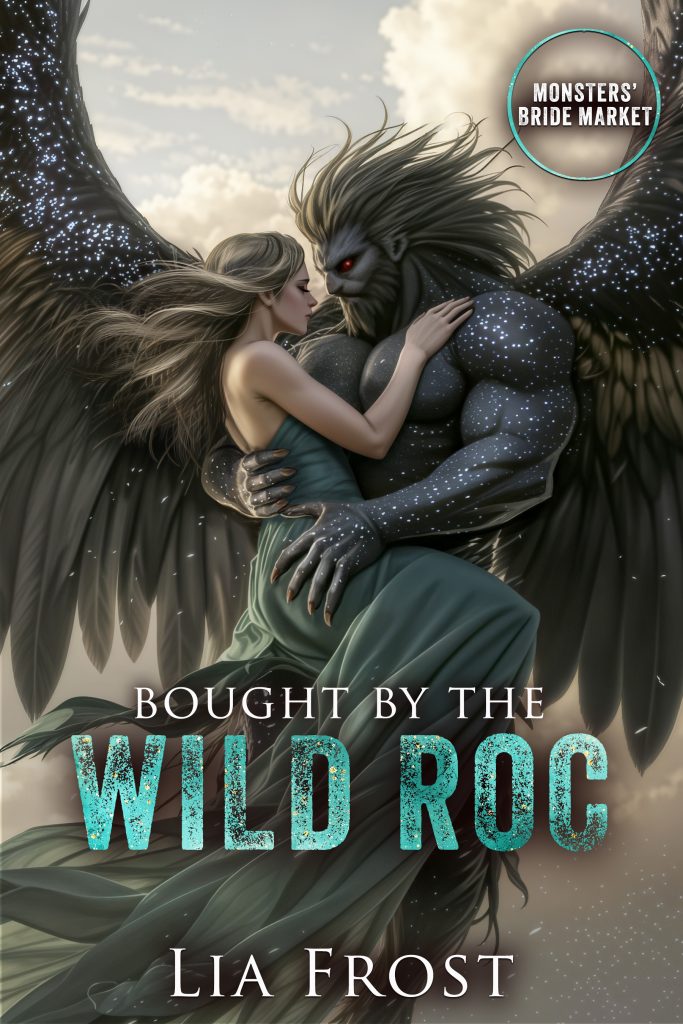
Wren
My hand reached for Elspeth before my eyes opened. Habit. Eight years of shared beds. Empty sheets. Wrong bed. Wrong light. Wrong smell of cedar and stone instead of mildew and my uncle’s tobacco smoke.
I sat up too fast, heart slamming, and then I remembered.
The monster. The flight. The way he’d looked at me in the hallway like I was something he couldn’t stop staring at.
I pressed my hand flat against my chest and made myself breathe. Counted the beats until they slowed. Told myself I was safe. That this was better than the alternative. That I’d made the right choice.
There was food outside my door.
A tray on the stone floor. Bread still warm from the oven. Cheese. Dried fruit. A pot of dark honey and a knife to spread it with. Everything arranged with a precision that made my chest hurt. Each item placed exactly parallel to the others. The knife at a perfect right angle to the bread.
No note. No instructions. Just evidence that he’d been awake before dawn, arranging food for me like it mattered where the honey pot sat.
I ate standing at the window because I couldn’t sit still. The honey was wild and dark, nothing like the thin stuff from market stalls, and I kept thinking about his hands. How carefully they must have placed that knife. How those same hands had trembled last night when he’d buckled me against his chest.
The Aerie was a maze of empty rooms.
I wandered through corridors carved into the mountain itself, trailing my fingers along cold stone, opening doors that hadn’t been touched in decades. Dust on the floors. Furniture draped in cloth gone gray with age. The particular silence of spaces that had given up waiting for someone to fill them.
All those empty rooms. All that silence. I found the library by accident and stopped breathing.
Books. Thousands of them. The chamber was vast, ceilings disappearing into shadow, and every surface was covered. Floor to ceiling shelves. Stacks on tables. Piles in corners. Books spilling off chairs and heaped against walls and crammed into spaces too small for them.
I walked forward without deciding to. My hand found a spine. Leather, cracked with age, gold lettering in a script I didn’t recognize. I opened it and the pages were brittle but intact, filled with flowing handwritten text that might have been three centuries old.
I put it back. Pulled another. A treatise on astronomy, printed in Common Tongue. Next to it, poetry in Old Imperial. Next to that, a cheap novel with a woman fleeing a castle on the cover. Elspeth would have loved this one. She’d always begged me to read her the dramatic parts twice, acting out the voices until she laughed so hard she couldn’t breathe. I hadn’t read to her in years. Hadn’t had time. Hadn’t had books.
Next to that, someone’s personal journal, leather worn soft from handling.
No organization. No system. Languages and eras and subjects all tangled together like someone had simply acquired them and shoved them wherever they would fit.
And then I noticed the shelf by the window. All the books were arranged by color. Deep reds fading into burgundy fading into rust fading into orange fading into gold.
A perfect gradient, spine to spine. I pulled one out. Written in a language I’d never seen before. Another. Different script. Another. Another.
Why would someone organize books by color?
I found the bestiary on a lower shelf, wedged between a water-stained atlas and something that might have been a cookbook. Old leather, cracked spine, illustrations done in faded ink.
I almost missed the entry. Just a paragraph, tucked between “Salamanders, Greater” and “Sphinxes, Desert.” But the word caught my eye: Roc.
The Sky Jewel, the text read, is produced once in a Roc’s lifetime, crystallized from their own magical essence during their first century of maturity. The process is said to be painful, lasting several days, and the resulting gem contains a fragment of the Roc’s life force. For this reason, Sky Jewels are never sold or traded lightly. To gift one is to gift a piece of oneself.
I thought about the auction. The auctioneer’s pale face. The way Sorley had decided I wasn’t worth dying for.
Tavrin had given a piece of his soul for me.
I closed the book carefully and didn’t mention what I’d found.
“You found it.”
I spun. He filled the doorway, silent as smoke, watching me with those amber eyes. I hadn’t heard him approach.
“How long have you been there?”
“A few minutes.”
“That’s unsettling.”
“I know.” He didn’t apologize. Didn’t explain. Just watched me the way he’d watched me in the library, like I was a book in a language he was trying to learn.
“These are organized by color,” I said, gesturing at the window shelf.
His jaw tightened. “Yes.”
“Why?”
Silence. His hands flexed at his sides.
“It is all I can see in them,” he said finally. “I cannot read most of them.”
“How many can you read?”
He looked at the shelves. At the thousands of volumes crammed into every available space. “Perhaps one in five. Perhaps less.”
I waited.
“Reading requires teaching.” The words came slowly. “I have been alone a very long time. The traders who sometimes came to the mountain’s edge… they wanted to sell, not to teach. And I…” He stopped. Started again. “I kept buying. I kept thinking, someday. Someone would come. Someone would read them to me.”
The weight of that settled into my chest. Collecting words he couldn’t decipher. Building a library for a person who hadn’t arrived yet.
“Then why do you have them?”
The silence stretched. His hands flexed at his sides, that tell I was starting to recognize. The one that meant he was holding something back.
“I do not know,” he said finally. “When I see a book, I feel… compelled. To bring it here. To keep it.” He stopped. His jaw worked. “I have been doing this for a very long time. I have never understood why.”
“That’s hoarding.”
“Yes.” No defense. No excuse.
“That’s not healthy.”
“No.”
I should have left it alone. Should have made a polite noise and changed the subject. Instead I heard myself say: “Do you hoard other things? Or just books?”
His eyes met mine and held. Something was happening in them. That flicker in his pupils, the one I’d first seen at the market.
“I did not,” he said slowly. “Before.”
“Before what?”
He didn’t answer. But his fists clenched and unclenched, and he looked at me the way he’d looked at the books. Like I was something he needed to keep.
I turned back to the shelves because I couldn’t hold his gaze anymore.
“I’m going to organize this,” I said. “It’s going to take months. Maybe years. But I’m going to put every single book in a system that makes sense.”
“You do not have to.”
“I know. I want to.” I pulled a book off a lower shelf. Heavy, leather-bound, illustrations on thick pages. “I need supplies. Paper, ink, something to write on. And I’ll need you to tell me which languages you can read so I know how to sort them.”
“I will get them.”
He left. I started examining the shelves, trying to understand the scope of the chaos, and before I’d finished a single wall he was back.
Paper. Ink. A lap desk. Three different pens.
“Is this sufficient?”
“Yes, but I didn’t need three different—”
He was already gone.
He came back with cushions. Two of them, silk-covered, deep blue.
“For the chair,” he said. “The wood is hard.”
“Tavrin, I don’t—”
Gone again.
A blanket. Wool, thick, the color of storm clouds.
“The stone floor is cold. You will want this.”
“I’m not cold.”
He draped it over the chair anyway and disappeared.
A pitcher of water. A cup. A plate of food I hadn’t asked for.
I watched him arrange them on the small table he’d brought three trips ago. His movements were careful. Precise. That same rigid exactness I’d seen in the breakfast tray.
“You don’t have to keep bringing me things.”
“I know.” He straightened. Looked at the arrangement. Adjusted the cup slightly. “I will return.”
“Tavrin.”
He stopped in the doorway.
“I mean it. Stop bringing things.”
He stood very still. I watched his hands open and close at his sides. Watched his shoulders tighten. Watched something ripple across his face that looked almost like pain.
“Yes,” he said. “Of course.”
He left.
I went back to work. I told myself I was relieved. Told myself the constant interruptions had been breaking my concentration. Told myself this was better.
Twenty minutes later I heard movement in the doorway.
He was standing there with a footstool in his hands. His expression was somewhere between apologetic and anguished.
“I tried,” he said. “I cannot seem to stop.”
I should have been annoyed. Should have told him to leave, to give me space, to stop hovering. But he looked so wrecked. Standing there with a footstool he didn’t know why he’d brought, staring at me like he was waiting for me to tell him he was broken.
“Why?” I asked. “Why can’t you stop?”
“I do not know.” The words came out rough. “You need things. I can feel that you need things. And when I am not bringing them to you, there is a sound in my head. Like screaming. I do not know how to make it stop except by—” He lifted the footstool helplessly. “I am sorry. I know this is strange. I know I am making you uncomfortable.”
“You’re not,” I said, and realized it was true.
He went still. “I am not?”
“You’re making me nervous. That’s different.”
“How is that different?”
I stood up from my chair and walked toward him. His eyes tracked every step. He didn’t move, didn’t breathe, just watched me approach like I was something dangerous.
“Uncomfortable is wanting to leave,” I said. “Nervous is wanting to stay but not knowing if you should.”
“Which do you want?”
I stopped in front of him. Close enough to feel the heat pouring off his skin. His eyes shifted again, gold swallowing the amber, like something inside him was fighting to get out.
“Give me the footstool,” I said.
He handed it over. His fingers brushed mine. Fever-hot, just like last night.
“Thank you.” I turned and walked back to my corner and put it exactly where my feet would rest. “You can bring one more thing. One. And then you have to sit down somewhere and stay still for at least an hour. Can you do that?”
“Yes.” He said it like I’d given him a gift instead of an ultimatum. “Yes, I can do that.”
He disappeared. I went back to cataloging. And when he came back, he was carrying a lamp, larger and brighter than any I’d seen in the Aerie, and he set it on the table with that same anxious precision and then settled on the floor by the door.
He watched me work for three hours without moving.
I felt it the entire time. His attention like a physical weight. Not threatening. Just there. Constant and steady. Like I was a fire and he’d been cold for two hundred years.
“You can do something else,” I said without looking up. “You don’t have to just sit there.”
“I know.”
“It doesn’t bother you? Just watching?”
“No.”
I made myself keep working. Made myself focus on the books, the lists, the systems I was building out of chaos. But my hands weren’t steady anymore. I kept making mistakes. Kept losing my place.
“Why me?”
The question came out before I could stop it.
“I do not understand.”
“At the market. You could have bought anyone. Why me?”
Silence. I forced myself to look at him. He was still sitting by the door, perfectly motionless except for his hands. They were gripping his knees so hard I could see the tendons standing out.
“I saw you,” he said.
“You saw all of us.”
“No. I saw you.” He swallowed. His eyes shifted again, gold swallowing the amber. “The others were performing. Crying or smiling or trying to look appealing. You were just… standing there. Looking at the crowd like you were cataloging them. Counting the exits. Planning.”
“So you bought me because I wasn’t crying?”
“I bought you because you looked at me.”
I remembered. That moment on the platform when I’d felt someone watching. When I’d found him in the crowd. When our eyes had met.
“Everyone was looking at you,” I said. “You’re seven feet tall.”
“Everyone was looking at the monster.” His voice had gone quiet. “You were the only one who looked at me.”
I didn’t know what to say to that. My throat had closed around something sharp.
“You keep doing that,” I managed.
“Doing what?”
“Saying things I don’t know how to answer.”
“I am sorry.”
“Don’t be. Just…” I shook my head. “Warn me next time. Before you say something that makes me want to…”
I stopped. I’d been about to say cry. But that wasn’t quite right either.
He stood up. Crossed the room in three steps. Stopped in front of me, close enough that I had to look straight up to find his eyes.
“Makes you want to what?” he asked.
“I don’t know.” The words came out barely a whisper. “Something. I don’t know what.”
He reached out. His hand stopped just before touching my face. I could feel the heat of him, hovering, waiting.
“You are worth more than your usefulness,” he said. “I need you to know that. Whatever else happens, whatever you decide about this place, about me, I need you to know: you do not have to earn your place here. You do not have to organize my library or teach me to read or be productive in any way. You are allowed to simply exist.”
“Nobody gets to just exist.”
“You do. Here. With me.” His hand was shaking. I could see it trembling in the air between us. “I had forgotten what wanting felt like. And then I saw you standing on that platform with ink on your chin.”
“Tavrin—”
“I am not telling you this to make you feel obligated. I am telling you because you keep talking about being useful, being valuable, being worth keeping, and I need you to understand.” His eyes were burning now, gold bleeding through the amber. “I would keep you if you did nothing. If you never organized a single book. If you never spoke to me again. I would keep you because you exist, and I cannot fathom a world where you do not exist in this place with me.”
His words came easier in the mornings, I’d noticed. Clear and fluid, almost human. By evening, the fragments returned—the pauses, the searching, the frustrated flex of his hands when language failed him. I learned to save important conversations for dawn, when the man was strongest and the beast was quiet.
This was a morning conversation. I tried not to think about how many mornings we had left.
I stared at him. My pulse hammered against my ribs, a frantic rhythm.
“That’s terrifying,” I said.
“I know.”
“You basically just said you’re obsessed with me and we’ve known each other for a day.”
“I know.” His hand was still hovering. Still trembling. “Do you want to run?”
I thought about it. Really thought about it. About my uncle’s house where I’d been a tool. About the creditor at the market who’d looked at my hips. About every person who’d ever seen me as something to use.
And then I thought about Tavrin. I thought about the books arranged by color. About his hands shaking because he was fighting so hard not to touch me.
“No,” I said. “And that’s what’s terrifying.”
Something gave way in his expression. The careful control, the rigid stillness, all of it crumbling. He made a sound that wasn’t quite a word. Relief and want and something that might have been pain.
His hand finally touched my face. Just his palm against my cheek. Burning hot.
“I am going to be very careful with you,” he said. “I am going to be so careful. I need you to know that.”
“And if I don’t want careful?”
His breath caught. His pupils blew wide, the amber swallowed by black.
“Then we will discuss it,” he said roughly. “Later. When I am more in control of myself.”
He pulled his hand away. It looked like it cost him something. He stepped back, and then back again, putting distance between us.
“I should go,” he said. “You should work. I should—” He stopped. His hands were clenched into fists at his sides. “I will see you at dinner.”
He left before I could answer.
I stood there in the golden lamplight, surrounded by cushions and blankets and all the things he’d brought me, and pressed my hand against my cheek where his palm had been.
Still warm. Even after he was gone.
I thought about his hand on my face and his expression when he saw me like I was the only real thing in the world.
Can’t wait for this book to be released! Love it already 🥰
This sounds so mesmerizing, hopefully it won’t be too long before release date.